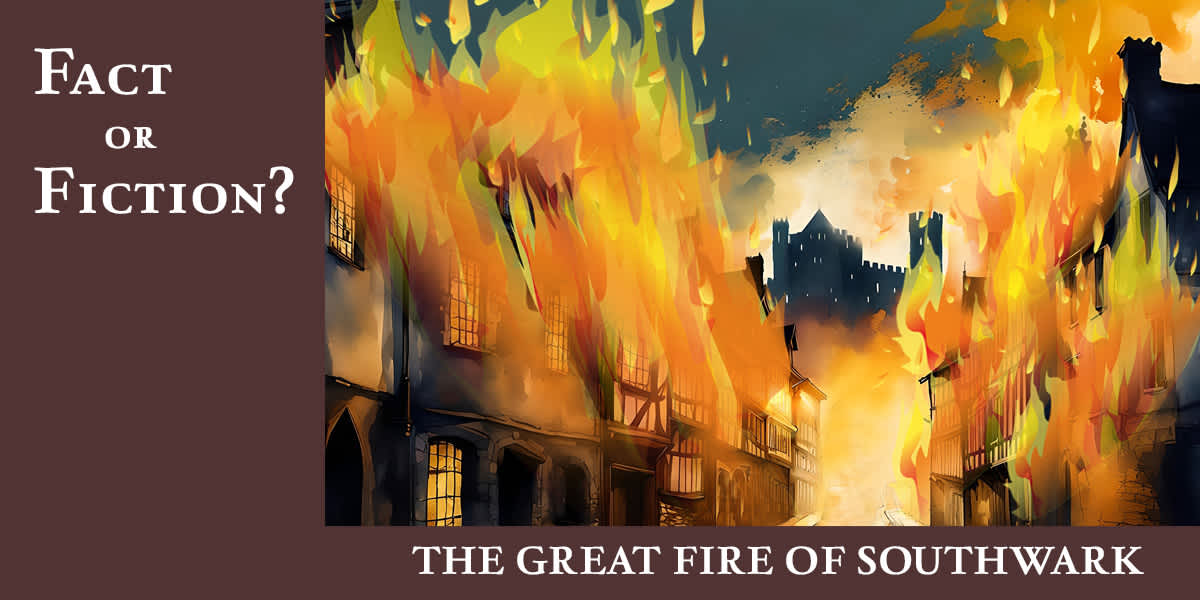
In The Saracen’s Dagger, Anabel Prescote lost her partner, shop and home in the Great Fire of Southwark when the blaze tore through the south bank of the River Thames in July 1212. It remains one of the most devastating yet frequently overlooked tragedies in British history. While the famous blaze of 1666 dominates the public consciousness, this thirteenth-century inferno, which occurred during the reign of King John, resulted in a loss of human life that far exceeded that of its more famous successor.
London in the summer of 1212 was a tinderbox, parched by weeks of exceptional heat and drought. The district of Southwark was packed with timber-framed homes and shops with thatched roofs of straw and reed. When a spark ignited a fire on or around July 10th, strong southerly winds whipped the flames into an unstoppable wall of fire that consumed everything in its path and gutted the historic Priory of St. Mary Overie.
The horror of the disaster unfolded on London Bridge, completed in stone just three years earlier. King John had authorised the construction of wooden houses, shops, and a chapel directly on the narrow span to generate revenue for the bridge’s maintenance. As Southwark began to burn, a crowd of citizens from the northern side of the river rushed onto the bridge, some eager to help extinguish the flames, others merely seeking to view the spectacle. At the same time, terrified Southwark residents fleeing north across the same narrow passageway created a massive human bottleneck on the bridge. When the wind carried red-hot embers across the Thames, they ignited the wooden structures at the northern end of the bridge, trapping thousands of panicked people in a blinding, smoky alleyway, with raging fires blocking both exits.
The toll on human life was catastrophic. In his sixteenth-century chronicles, the antiquarian John Stow estimated that more than three thousand people perished that night. With London's population at around fifty thousand, this meant roughly seven and a half per cent of the city’s inhabitants died in a matter of hours. People were asphyxiated by smoke, burned alive, or crushed in the desperate stampede. Many leapt from gaps in the bridge into the river below, but the rescue boats sent to save them were quickly overwhelmed by panicked swimmers, capsized, and drowned dozens more. While the stone pillars of the bridge survived, the wooden structures and vast swathes of land on both sides of the river were reduced to ash, leaving thousands homeless. In a strange twist of historical fate, the destruction of the Priory of St. Mary Overie forced the ruined infirmary to rebuild on a separate plot of land, establishing St. Thomas's Hospital, an iconic medical institution that still operates in London today.
The failure of medieval bucket brigades to contain the inferno forced London’s authorities to take drastic action. Henry Fitz-Ailwyn, London’s first mayor, introduced strict new building regulations that would permanently reshape the city. Thatched roofs were banned within the city limits, and all new homes were required to be roofed with tiles, shingles, or boards, while existing thatch was to be plastered over for fireproofing. The city also launched a concerted effort to replace timber frameworks with stone wherever citizens could afford to do so. These early building regulations proved remarkably effective, until the more famous fire tore through the city some four centuries later.